
By Rebecca R. Falkoff, Wolfsonian Research Fellow
In a widely circulated 1898 speech, prominent British scientist William Crookes echoed earlier predictions that the world's growing population would soon outstrip its food supply.1 Imagining a world of colonized land and exhausted soil, Crookes proposed atmospheric nitrogen could be harnessed to produce fertilizer—boosting agricultural production and declaring that "starvation may be averted through the laboratory."2
The key element in using "the laboratory" to stave off mass starvation was nitrogen—which drives plant growth, leaf development, and the creation of chlorophyll needed for photosynthesis. By the late 19th century nitrogen-rich materials (such as guano from Peru) were being depleted, raising the specter of declining yields. In addition, growing demand for explosives in construction and warfare put further pressure on nitrogen supplies, since nitrogen was vital to their production. All of this led to a search for a way to "capture" abundant atmospheric nitrogen and "fix" it to other elements to convert it into a useable form. A breakthrough was achieved in the early 20th century through the Haber-Bosch process, which produced ammonia, a reactive compound that could be used in both fertilizer and explosives.
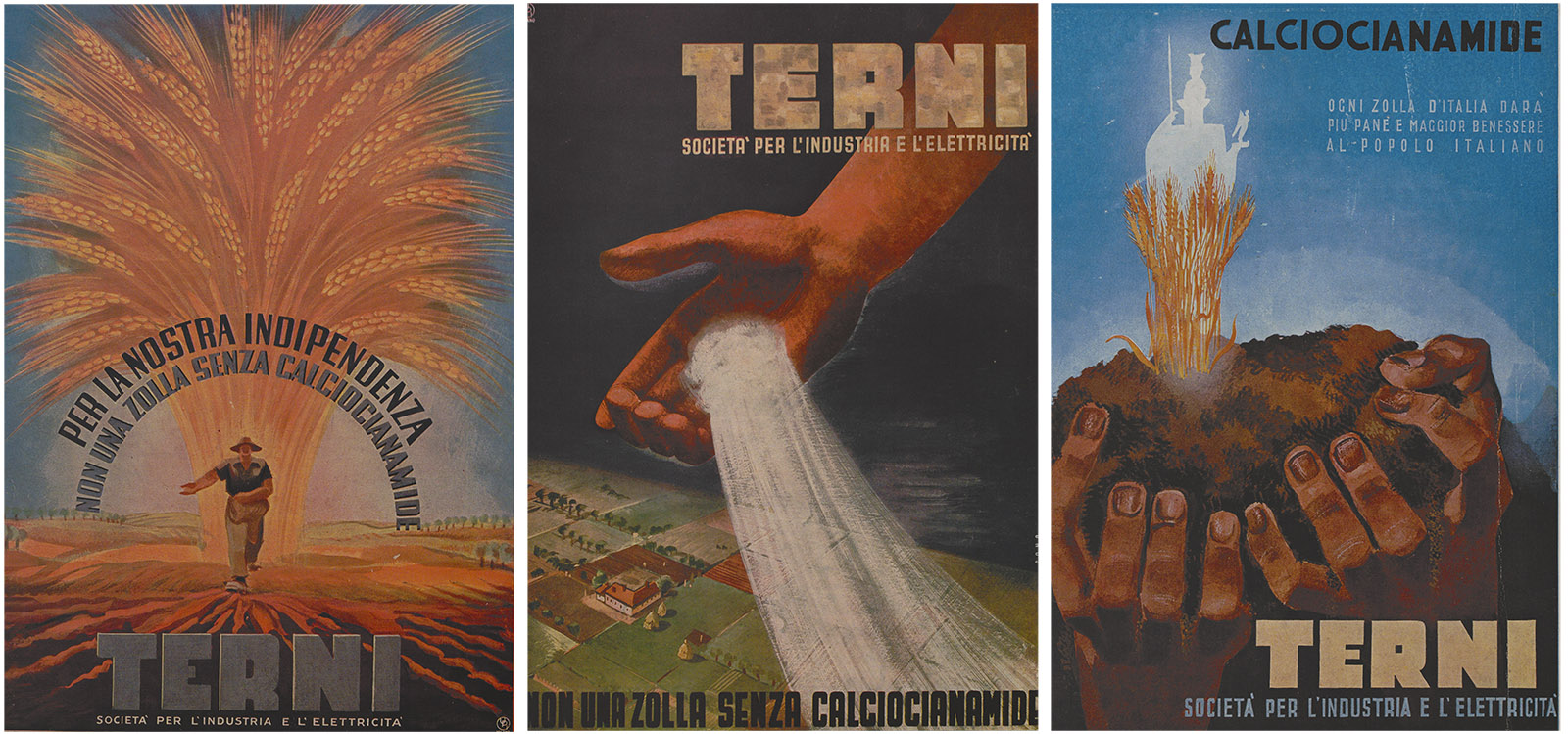
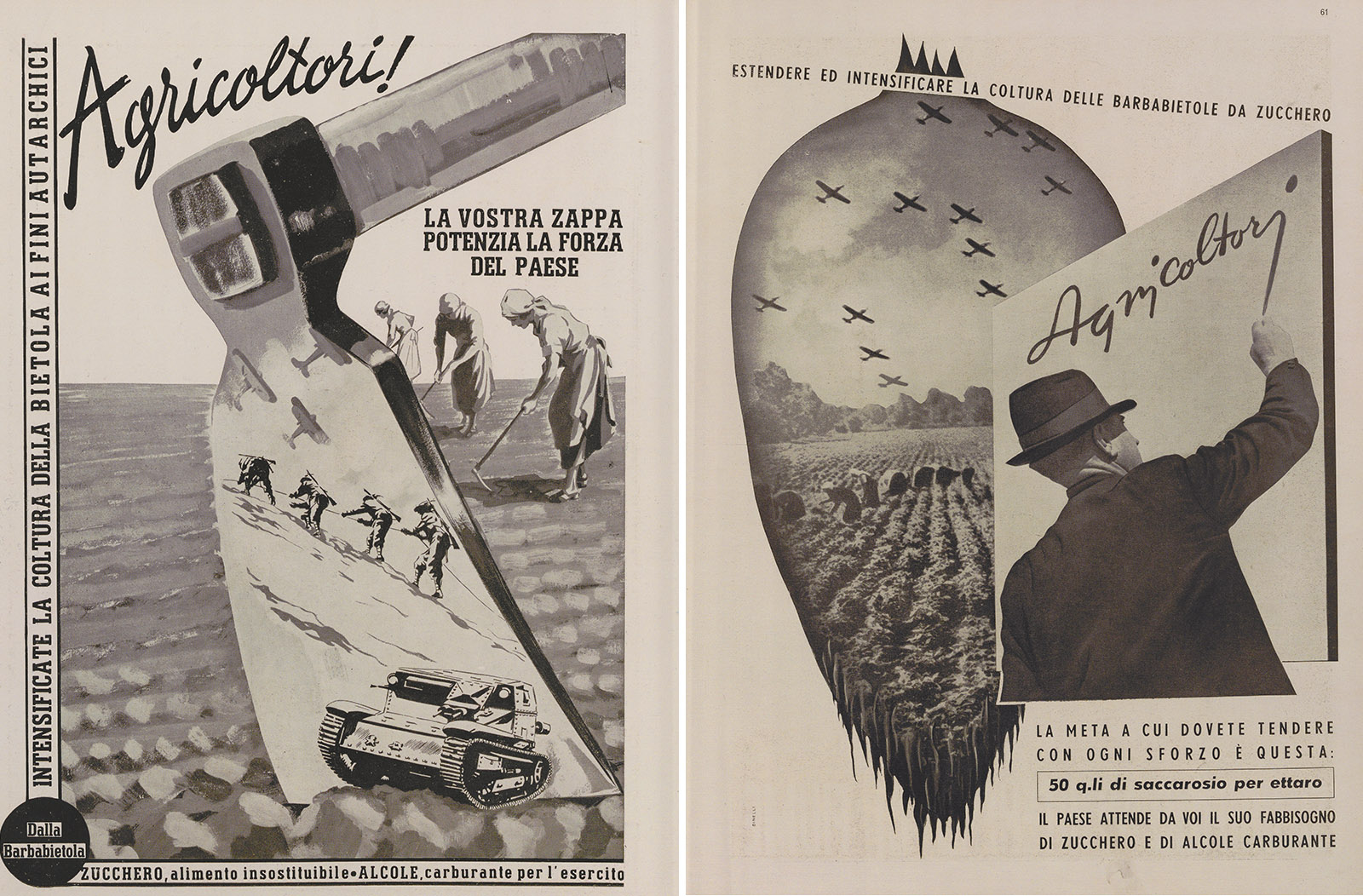
Magazines, La Rivista illustrata del Popolo d'Italia [The Illustrated Magazine for the Italian People], 1938–39. Milan, Italy. The Wolfsonian–FIU, Gift of Steve Heller, 83.3.186.175, 83.3.186.180, 83.3.186.187.
Using this process, Germany was able to produce the explosives needed to continue fighting in the First World War despite being cut off from Chilean saltpeter. In the postwar period, industrialized nations raced to develop rival processes to produce synthetic ammonia and related chemicals. Italy fared well in this contest: Luigi Casale patented a method celebrated in the domestic and international trade press and licensed more widely abroad than any rival, though a process developed by Giacomo Fauser quickly gained dominance within Italy after it was adopted by the chemicals giant, Montecatini. Addressing a general reader in 1928, Fauser glorified the "century of nitrogen," when "every nation will easily be able to provide bread for its people, and the world, becoming richer, will surely also be more peaceful."3 Advertisements produced by electrical power company Terni show how calcium cyanamide—a slow-release nitrogen fertilizer—was envisioned to not only boost crop efficiency, but also to provide greater prosperity for the Italian people.
In addition to tracing a cultural history of nitrogen capture in Italy, my research examined how using nitrogen from the air to enrich the soil, or "making bread from air," shaped ideas about nature in fascist Italy. As Montecatini invested heavily in nitrogen products, it also undertook innovative marketing methods, like producing the documentary Azoto (1937 or 1938), directed by Umberto Rossi. The film opens by capturing nitrogen's dual role in sustaining life and enabling warfare: "Nitrogen creates life and defends it." Rather than acknowledging nitrogen's role in warfare, the film frames it as something that 'defends' life, softening its association with violence. In an article found in The Wolfsonian collection, author Luigi Poli acknowledges the propagandistic potential of documentary filmmaking, mentioning Azoto.
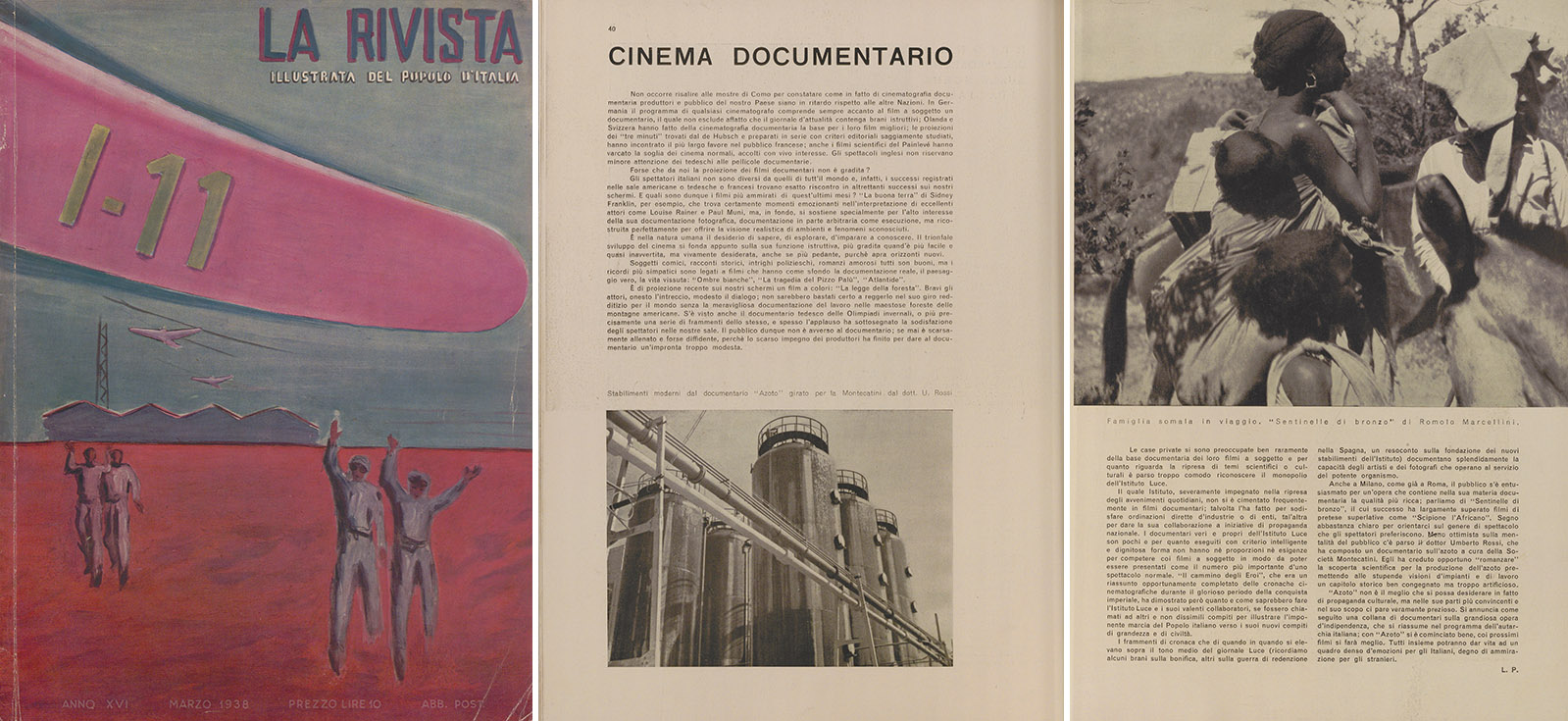
Magazine, Rivista illustrata del Popolo d'Italia [The Illustrated Magazine for the Italian People], March 1938. Luigi Poli, author. Milan, Italy. The Wolfsonian–FIU, Gift of Steve Heller, 83.3.186.167.
Fertilizers and other compounds made using atmospheric nitrogen are "synthetic": although the nitrogen comes from air, other elements must be "fixed" or "attached" to it using industrial processes. Fascist Italy also used the broad notion of synthesis to reconcile conflicting goals, like the national emphasis on self-sufficiency and imperial expansion, or on traditional rural life and industrial modernity.
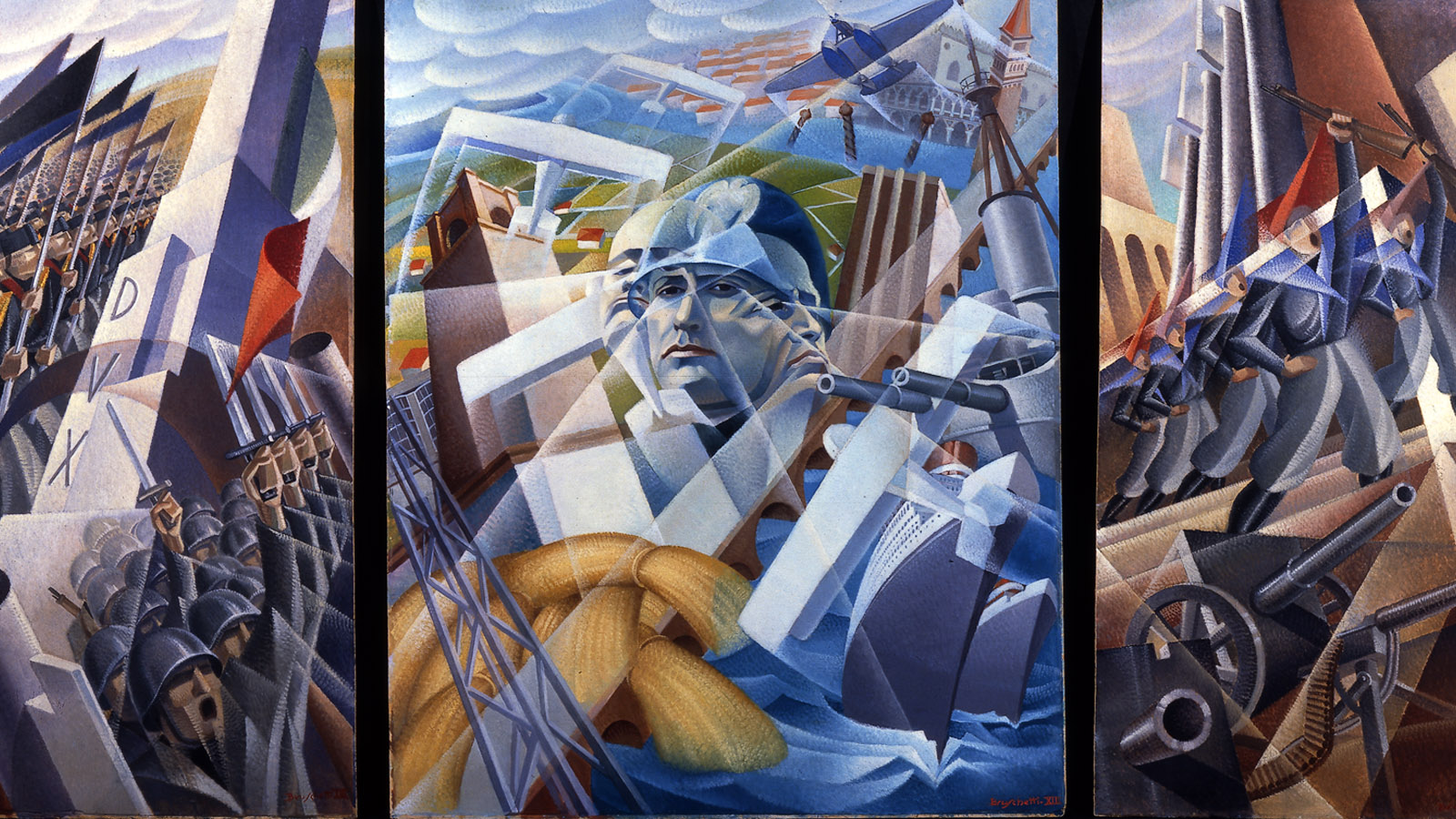
The Wolfsonian collection includes a striking vision of these syntheses in the futurist aeropainter Alessandro Bruschetti's 1935 oil-on-plywood triptych Sintesi fascista [Fascist Synthesis]. At the center of the triptych are three overlapping portraits of Mussolini whose gaze is intended to radiate energy to power the transformation of Italy. The products of modern industry—a fleet of biplanes, a seaplane, a radio tower, a warship, and an ocean liner—are overlaid on a landscape primed for their production, its waterways harnessed to generate hydroelectric power, its clouds echoed in the curves of bundles of wheat. Bright blues and greens dominate the central panel, suggesting the vitality of the fascist synthesis of nature and culture in modern technologies. The flanking panels, which use muted earth tones, depict soldiers whose bodies, uniforms, and weapons intersect with and dissolve into the Mussolini obelisk and the environment. The repeating lines and curves reinforce the painting's central theme of synthesis, visually uniting people, nature, and symbols of the fascist state.
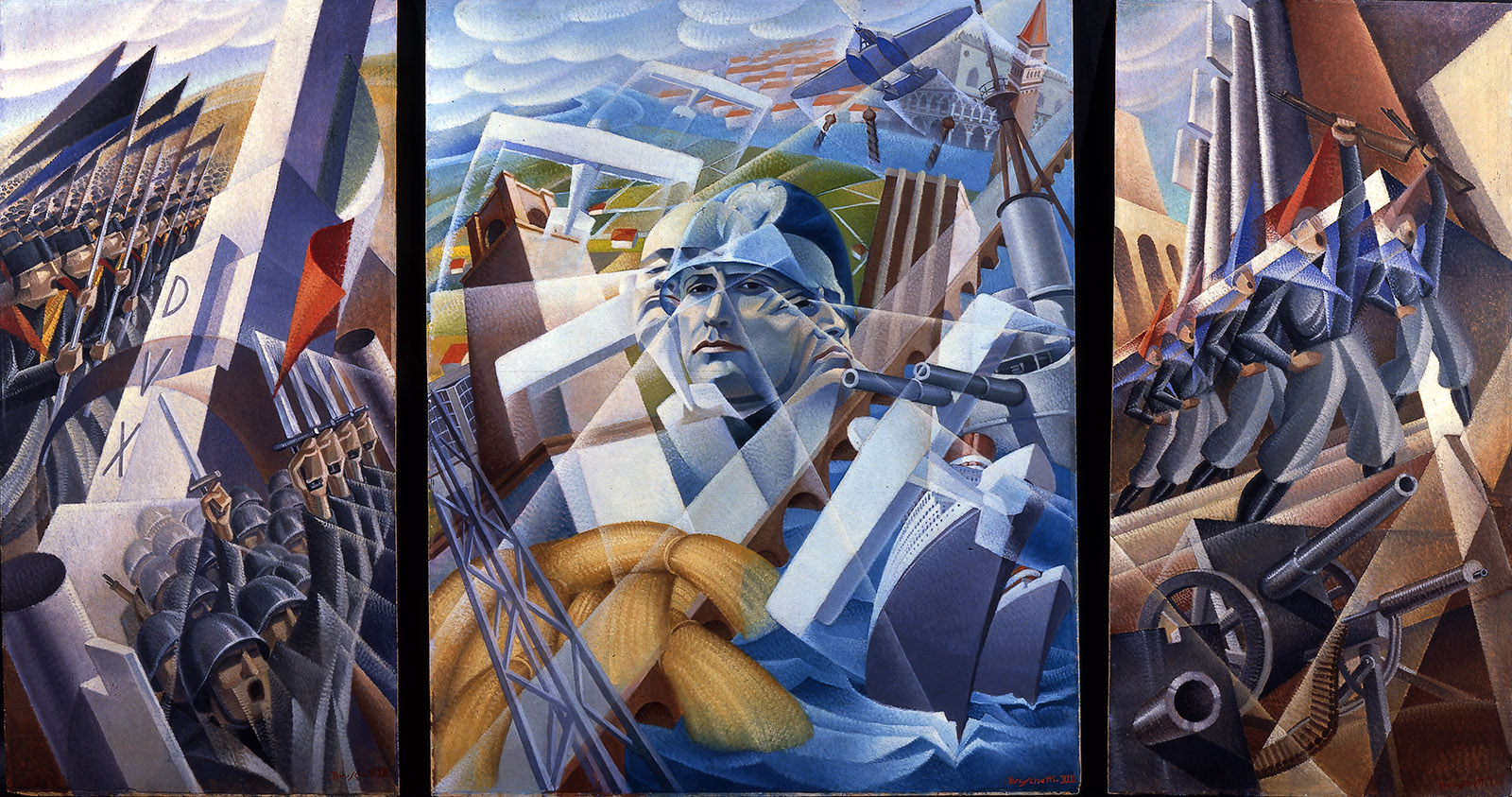
Painting, Sintesi Fascista [Fascist Synthesis], 1935. Alessandro Bruschetti, artist. The Wolfsonian–FIU, The Mitchell Wolfson, Jr. Collection, 84.5.43.1–.3.
By the mid-1930s, Italy had established a robust synthetic fertilizer industry; the nitrogen problem that had dominated attention in the earlier decades was largely solved. Texts at The Wolfsonian illustrate how the language of synthesis extended to textiles, sugar-based biofuels, and other products. The 1940 volume Autarchia chimica [Chemical Autarky] highlights other chemical developments, particularly fossil fuels and alternatives like ammonia and derivatives from sugar beets. Beginning in the late 1930s, the Rivista illustrata del Popolo d'Italia included several features about sugar and related chemicals. Virtually every issue contains a full-page advertisement encouraging farmers to grow sugar beets to power both people and machines.
These developments were foreshadowed by science writer Egisto Roggero, who observed in his 1930 book Enimmi della scienza moderna: realtà di domani [Riddles of Modern Science: Tomorrow's Reality] that modern chemistry had ushered in "the absolute triumph of the substitute": synthetic ivory contained no ivory, artificial silk no silk. In other words, chemistry increasingly promised substitutes for nature itself. While nitrogen receded in strategic importance, the discourse of scarcity and synthesis it pioneered became a model for fascist visions of total and totalitarian transformation.
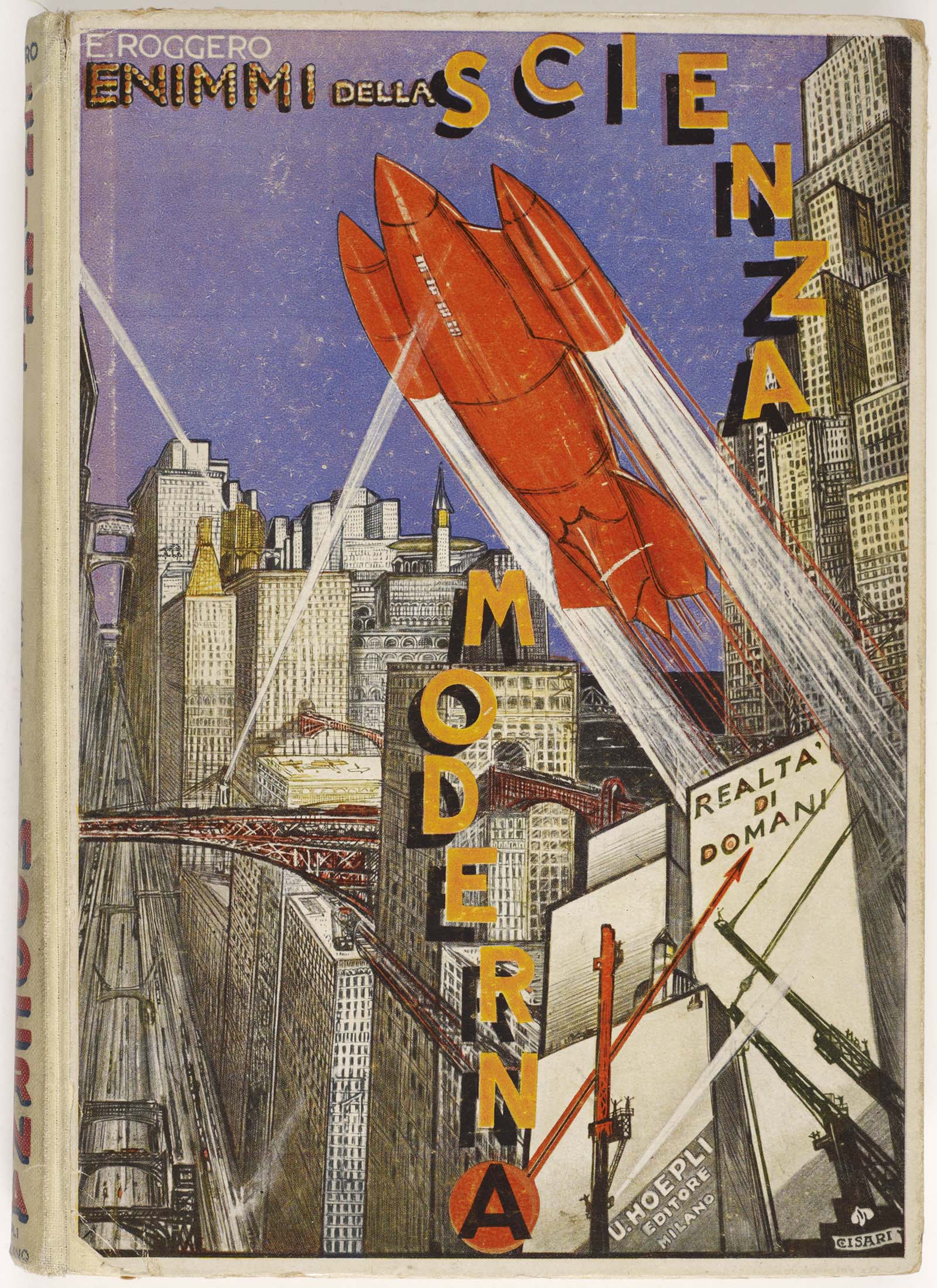
Book cover, Enimmi della scienza moderna: realtà di domani [Riddles of Modern Science: Tomorrow's Reality], 1930. Giulio Cisari, cover designer. Egisto Roggero, author. Ulrico Hoepli, Milan, Italy, publisher. The Wolfsonian–FIU, The Mitchell Wolfson, Jr. Collection, XB1990.1085.
Materials at The Wolfsonian have helped me trace how ideas about nitrogen and the rhetoric of synthesis expanded from chemistry into art and visual culture. While nitrogen capture promised an age of abundance by solving the problem of scarcity, its history reveals a different lesson: technological plenty empowered nationalist violence and environmental destruction. The crisis was never one of scarcity or depletion, but of distribution—and the violence required to sustain abundance for some at the expense of others and the environment itself.
Endnotes
- William Crookes, "President’s Address," Report of the Sixty-Eighth Meeting of the British Association for the Advancement of Science, Held at Bristol in September 1898 (London: John Murray, 1899): 3–38, p. 13.
- Ibid., p. 14.
- Giacomo Fauser, "Il secolo dell'azoto," Realtà: Rivista mensile del Rotary Italiano (1 Oct. 1928): 337–349, p. 349.
About the Author
Rebecca Falkoff is an assistant professor of Italian Studies at The University of Texas at Austin and completed a Wolfsonian Research Fellowship in 2025. Her research interests include Italian literature, cultural studies, and environmental humanities. Falkoff's forthcoming book, Industrious Skies, explores the use of nitrogen capture in fascist Italy to support the regime's industrial and cultural ambitions.